10/17/2022
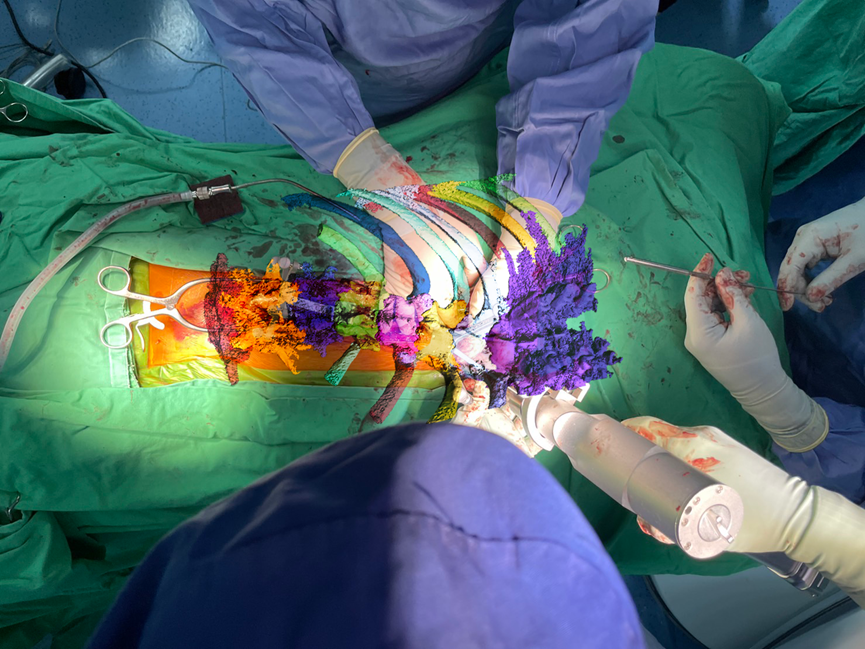
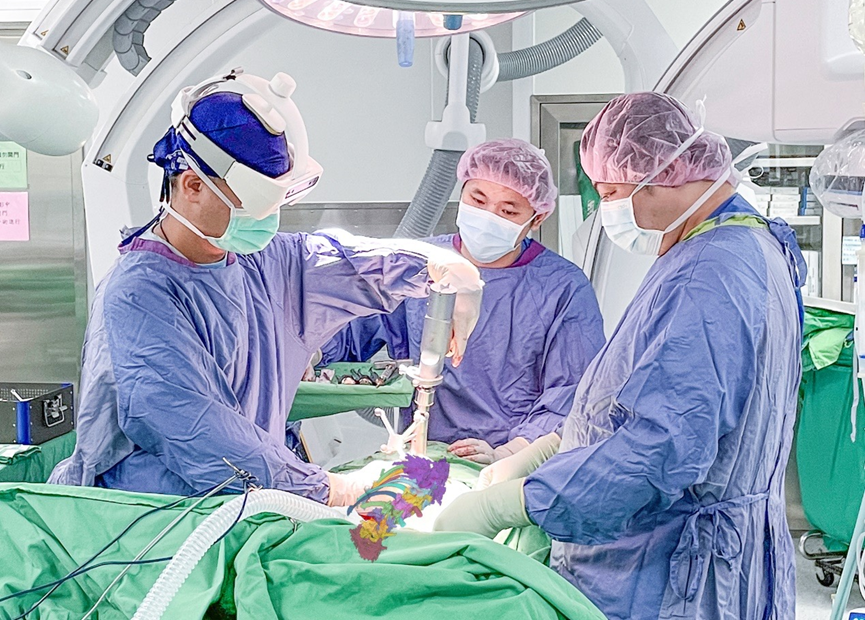
On October 17, 2022, the neurosurgery team at Taichung Veterans General Hospital performed the first spinal scoliosis correction surgery in Taiwan using augmented reality (AR) glasses combined with intraoperative navigation technology. The patient, a 27-year-old female with a 58-degree spinal curvature, underwent surgery in a hybrid operating room where real-time 3D scanning of the spine was conducted to obtain immediate spinal images. Augmented reality glasses and intraoperative navigation systems were then employed, allowing the 3D images of the spinal curvature to be projected onto the patient's body in real-time, visible to the surgeon. This technology provided the surgeon with a virtual perspective, enabling them to navigate around risky areas during surgery, reducing the risk of complications and significantly enhancing surgical safety. Moreover, it eliminated the need for traditional preoperative imaging and the time-consuming steps of image registration and positioning during surgery, resulting in a substantial reduction in surgical time.
10% of teenagers are troubled by spinal deformities
According to clinical surveys, the prevalence of spinal curvature among Taiwanese adolescents is approximately 5-10%. Surgery is recommended when the curvature exceeds 40 degrees. Recently, the neurosurgery team at Taichung Veterans General Hospital admitted a patient with a spinal curvature angle of 58 degrees. The patient complained of joint and muscle pain, decreased mobility, as well as recent difficulties in breathing, decreased appetite, and digestive issues due to the spinal curvature problem, causing significant distress in daily life. Director Yang Meng-yin of the neurosurgery spinal curvature treatment team stated that the patient had thoracolumbar scoliosis combined with spinal rotation. Traditional steel rod insertion surgery carries a high risk of error due to the significant angle variation. However, in this surgery, with the assistance of augmented reality smart surgical glasses and intraoperative navigation technology, the precision of steel rod placement was enhanced, reducing surgical time and the risk of complications.The patient's height increased by two centimeters after the surgery.3公分The curvature angle has been restored to 10 degrees after the surgery.以內The curvature angle has been restored to almost normal, upright posture.。
AR smart glasses assist in spinal surgery navigation, ensuring precise positioning and safety.
The AR technology used in this surgery at Taichung Veterans General HospitalThe smart surgeryThe glasses used in this surgery are the Caduceus S AR smart surgical glasses developed by SURGLASSES Corporation. This AR smart surgical glasses, combined with navigation system technology, obtained TFDA Class II medical device market clearance in the third quarter of this year. It's the first surgical-specific AR augmented reality spinal surgery navigation system approved by TFDA in Taiwan, offering a completely new surgical experience. It directly projects the surgical environment and relative positions, making the lesion location vividly visible and allowing surgeons to have better control over the entire procedure. This breakthrough will lead surgical medicine into a new era. The neurosurgery team at Taichung Veterans General Hospital promptly initiated the application of this system, conducting the first spinal curvature correction surgery approved by TFDA after clearance.
The technology of AR glasses combined with a navigation system is mainly divided into intraoperative scanning, intraoperative planning, 3D localization, AR glasses wearing, and real-time tracking display. After the patient is anesthetized and before the surgery begins, real-time 3D image data is obtained using the imaging equipment in the hybrid operating room. Within about 4 seconds, the image data is loaded into the system, allowing the patient's spinal image and navigation data to be directly projected onto the patient's body using augmented reality technology. The entire preoperative preparation process takes about 10 minutes, and with the AR smart surgical glasses, various spinal surgeries can be performed safely and intuitively immediately. Taiwan Bone King obtained TFDA Class II medical device market clearance in August 2022. The neurosurgery team at Taichung Veterans General Hospital promptly formed an expert medical team and conducted multiple simulated tests with Taiwan Bone King to familiarize team members with the operation process. This technology was then introduced and applied in actual surgeries, such as long-segment spinal curvature correction surgery. Due to the thorough simulated testing beforehand, even in the first surgery requiring the implantation of up to 24 pedicle screws for spinal curvature correction, the procedure demonstrated extremely high accuracy and therapeutic effects, bringing higher safety to patients.
AR technology enhances surgical safety
Director Yang Meng-yin stated: "This patient not only had curvature in both the thoracic and lumbar spine but also had accompanying spinal rotation deformity, making it a three-dimensional spinal curvature case. In the past, performing corrective surgery for such patients was a significant challenge.Within the spine lies the spinal cord, surrounded by major blood vessels such as the aorta and various organs. The slightest misstep could lead to potential harm to vital organs. Hence, the surgical procedure poses significant difficulty and challenges.also increases the patient's surgical time and the risk of complications. This surgery marks the first case in Taiwan to combine AR smart glasses, which project images onto the patient in real-time, with intraoperative navigation systems for executing complex spinal correction surgery. With the assistance of AR glasses, during the surgeryNo need to lift or turn the head.Physicians can fully focus on the surgical area, combined with intraoperative navigation systems, providing precise information on the angle, position, and depth of steel rod placement, as well as real-time spinal imaging. This allows surgeons to feel confident in each step of the pedicle screw insertion process, particularly when dealing with large-angle curvature combined with spinal rotation, avoiding critical spinal cord and vascular structures while precisely implanting the screws. This significantly enhances safety, reduces surgical time, and minimizes blood loss.
Dr. Wang Min-liang from SURGLASSES stated, "Technology always stems from humanity." Though it may sound like an advertising slogan, it holds especially true in the medical field. On the other hand, technological inventions always arise from meeting human needs. In other words, regardless of what advanced technology we develop, the ultimate goal is to serve and complement the practical needs of people. The development of AR smart surgical glasses by Taiwan Bone King is based on this principle. Our development of AR smart glasses stems from a belief: to allow surgeons to fully concentrate on the surgical area without being distracted by traditional navigation devices, enabling them to perform complex surgeries. I hope our AR glasses, combined with surgical navigation systems, can continue to fulfill their function and benefit all those in need. This is our original intention, and the recovery of patients' health is our greatest motivation.
The spinal curvature treatment team at Taichung Veterans General Hospital's neurosurgery department has consistently sought to enhance the safety and convenience of surgeries using advanced medical technology. Apart from being the first in Taiwan to adopt augmented reality technology in scoliosis correction surgeries, they have also explored using augmented reality technology for pre-surgical explanations and instructions. Their goal is to provide patients with a clearer understanding of the surgical procedures and risks beforehand, thereby reducing preoperative anxiety and unease.